




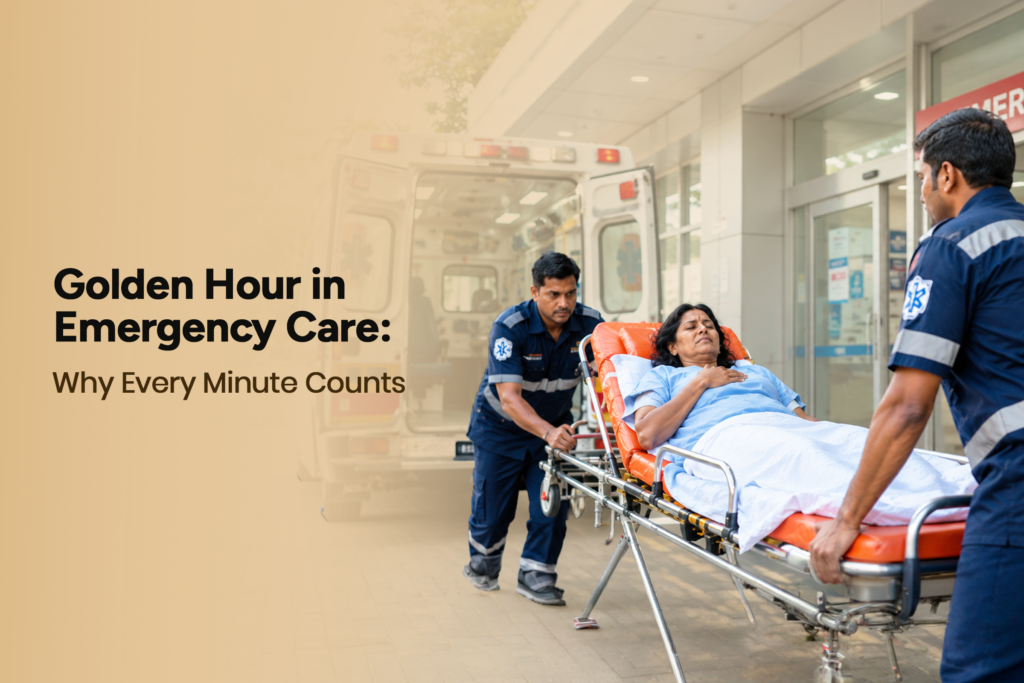
Golden Hour in Emergency Care: Why Every Minute Counts
Medical emergencies never give you advance notice. A normal drive down the East Coast Road, a regular evening at home, or an ordinary afternoon at work can turn into a life-threatening crisis in a matter of seconds. Whether it is a severe road accident, a sudden heart attack, or an acute brain stroke, what you do in the immediate aftermath matters more than anything else.
In the world of emergency medicine, the first 60 minutes after a traumatic injury or severe health event is known as the Golden Hour. This window of time is the single most critical period for saving a life. When medical care begins within this first hour, the chances of survival jump dramatically, and the risk of permanent physical damage drops significantly.
Understanding the principles of golden hour emergency care, knowing how rapid medical action saves vital organs, and being prepared to make quick choices can make you a true lifeline for someone in need. Let us look at why every minute counts during a crisis, what happens inside the body, and how emergency care works.
What Exactly is the Golden Hour?
The concept of the Golden Hour was originally introduced in trauma surgery by Dr. R Adams Cowley. His observations showed that patients who received definitive medical treatment within the first 60 minutes of sustaining severe physical trauma had substantially higher survival rates than those whose care was delayed.
Over time, this principle expanded beyond road traffic accidents to include acute medical emergencies such as:
- Sudden Heart Attacks: When a coronary artery is blocked, heart muscle cells begin dying within minutes.
- Acute Ischemic Strokes: When blood flow to the brain is cut off, roughly 1.9 million brain cells die every minute.
- Severe Physical Trauma: Uncontrolled internal or external bleeding can lead to shock and multi-organ collapse.
- Respiratory Failure: Without continuous oxygen, permanent brain damage occurs within four to six minutes.
The Golden Hour is not a rigid biological timer that stops at minute 61. Rather, it represents the critical early window where the human body is most responsive to medical stabilization before irreversible cellular damage sets in.
The Biological Race: What Happens to the Body in the First Hour
To appreciate the urgency of trauma response time, it helps to understand what happens inside the body during an acute medical crisis.
When a person experiences severe trauma, massive blood loss, or sudden cardiovascular failure, the body enters a protective state known as shock. In an effort to keep you alive, your sympathetic nervous system redirects blood away from your skin, limbs, and stomach to prioritize your brain and heart.
Without timely care, an emergency can quickly cause uncontrolled blood loss, starve cells of oxygen, build up harmful lactic acid, and lead to irreversible organ failure. On the other hand, receiving immediate medical care ensures rapid bleeding control, restores healthy oxygen circulation, minimizes long-term organ damage, and significantly improves the chances of survival and a full recovery.
If blood flow and oxygen delivery are not restored quickly, the body enters a dangerous downward spiral:
- Cellular Hypoxia: Without oxygen, cells switch to emergency anaerobic metabolism.
- Lactic Acid Buildup: This emergency energy process produces lactic acid, turning the blood acidic.
- The Trauma Triad: In heavy trauma, the combination of hypothermia (low body temperature), acidosis (acidic blood), and coagulopathy (inability of blood to clot) can quickly become fatal.
- Organ Failure: Starved of clean blood, the kidneys, liver, lungs, and heart begin to shut down one by one.
Delivering life-saving interventions within the Golden Hour stops this biological breakdown before it reaches the point of no return.
The Golden Hour Across Major Medical Emergencies
The value of the Golden Hour differs slightly depending on the medical situation. Here is how rapid response impacts specific health crises:
Road Traffic Accidents and Physical Trauma
Accidents on busy highways often involve complex fractures, head trauma, and hidden internal bleeding in the chest or abdomen. During the Golden Hour, emergency teams focus on controlling severe hemorrhages, stabilizing the spine, clearing the airway, and getting the patient into an emergency operating room for life-saving surgery.
Acute Heart Attacks (Myocardial Infarction)
During an acute heart attack, a blood clot blocks blood from reaching a section of the heart muscle. In cardiology, specialists use the phrase “time is muscle.” Restoring blood flow through emergency medications or a procedure in a Cath Lab within the first 60 to 90 minutes prevents permanent scarring and preserves normal heart function.
Acute Brain Strokes
Strokes occur when a blood vessel in the brain is blocked by a clot (ischemic stroke) or bursts open (hemorrhagic stroke). When specialists administer clot-dissolving medications within the Golden Window, stroke patients can regain speech, muscle control, and mobility, avoiding lifelong disability.
Severe Respiratory Distress and Poisoning
Whether caused by an acute asthma attack, toxic chemical inhalation, poisoning, or an allergic reaction, an airway blockage stops oxygen from reaching the brain. Rapid airway management and mechanical breathing support within minutes prevent sudden cardiac arrest.
Comparing Survival Outcomes: First Hour vs. Delayed Care
To help you see the dramatic difference timely medical attention makes, let us look at how early care compares to delayed treatment:
Emergency Condition | Care Received Within Golden Hour | Care Delayed Beyond 2 Hours |
Severe Trauma & Bleeding | Bleeding controlled; high ER survival rate; reduced risk of shock. | High risk of the trauma triad, severe organ failure, and poor survival. |
Acute Heart Attack | Heart muscle saved; lower risk of chronic heart failure; faster recovery. | Permanent heart muscle death; higher risk of cardiac arrest or long-term disability. |
Acute Ischemic Stroke | High likelihood of reversing paralysis; minimal speech and brain damage. | Extensive, permanent brain cell loss; potential long-term bed rest or paralysis. |
Airway Obstruction | Instant oxygen restoration; zero brain tissue damage. | Severe brain damage from lack of oxygen within minutes. |
What Happens Inside the Hospital: Emergency Department Protocols
When an emergency patient arrives at a specialized hospital, the emergency room does not operate on a first-come, first-served basis. Instead, it follows structured emergency department protocols designed to act with total precision.
Digital Triage and Rapid Assessment
The moment a patient arrives, triage nurses categorize the severity of their condition using standardized medical scales:
- Red (Immediate): Life-threatening conditions (cardiac arrest, severe head injury, heavy arterial bleeding) that require instant resuscitation.
- Yellow (Urgent): Serious injuries (stable fractures, deep cuts, moderate abdominal pain) that need care within minutes.
- Green (Non-Urgent): Minor injuries that can safely wait for attention while critical patients are stabilized.
Immediate Airway, Breathing, and Circulation (ABC) Resuscitation
Emergency doctors follow the foundational ABC rule:
- Airway: Ensuring the patient’s breathing passage is open and unobstructed.
- Breathing: Delivering high-flow oxygen or placing the patient on ventilator support.
- Circulation: Stopping active bleeding, inserting IV lines, starting fluids, and preparing emergency blood transfusions.
Rapid Diagnostic Evaluation
To treat an injury, doctors must locate it immediately. Modern emergency centers use point-of-care ultrasound, portable X-rays, and high-speed CT scans right inside or adjacent to the emergency bay. This allows specialists to detect internal abdominal bleeding or skull fractures in minutes without moving a critical patient across the hospital.
Seamless Specialist Mobilization
A strong emergency center alerts on-call specialists, such as neurosurgeons, orthopaedic trauma surgeons, and cardiologists, while the patient is still in transit. By the time the ambulance doors open, the surgical team and operating suites are fully prepped.
Practical Emergency Medicine Tips: What You Must Do
While doctors manage hospital care, the survival chain begins with the people at the scene. Here are practical emergency medicine tips you should follow if you encounter a medical crisis:
- Call for Professional Help Immediately: Never waste time searching for home remedies or debating whether to wait. Call local emergency numbers or direct hospital helplines right away.
- Control Bleed
- ing with Direct Pressure: If a person is bleeding heavily, take a clean cloth, towel, or shirt and press down firmly on the wound without letting go until medical workers arrive.
- Do Not Move Trauma Victims Recklessly: If an accident victim has potential neck, back, or head injuries, do not lift or twist their body unless they are in immediate danger from fire or traffic. Uncontrolled movement can sever spinal nerves and cause permanent paralysis.
- Never Give Food or Water: If someone is semi-conscious, vomiting, or complaining of severe chest or stomach pain, never give them water, tea, or food. If they require emergency surgery, having food in the stomach can lead to dangerous airway complications under anesthesia.
- Learn Basic CPR: Cardiopulmonary resuscitation keeps oxygenated blood flowing to the brain during cardiac arrest. Learning basic chest compressions can keep a loved one alive until paramedics arrive.
24×7 Emergency and Trauma Care: SMV Super Speciality Hospital
When an unexpected emergency strikes, having access to an integrated multi-specialty medical center makes the difference between life and death. SMV Super Speciality Hospital in Puducherry is fully engineered to deliver rapid, high-precision medical care during the critical care first hour.
Built on a foundation of clinical mastery and deep empathy, the hospital provides clear answers, honest medical advice, and rapid treatment pathways when every single second counts. Under the leadership of Founder, Chairman, and Managing Director M. Dhanasekaran, the hospital operates under a strict framework of 37 integrated international Standard Operating Procedures (SOPs) to guarantee clinical precision and total patient safety.
Full Infrastructure for Emergency and Critical Care
The hospital’s medical campus is built to handle complex multi-trauma cases, acute heart attacks, strokes, and pediatric emergencies under one roof:
- Puducherry’s Premier 24×7 Emergency & Trauma Center
- 400+ Patient Beds & 80+ Specialized ICU Beds
- Dedicated Trauma Bay, Resuscitation Area & Cath Lab
- Rapid Ambulance Fleet with Advanced Life Support
- On-Site 1.5T MRI, Fast CT Scan & Blood Bank Support
The emergency department features a specialized resuscitation bay designed for immediate airway management, CPR, and bleeding control. To support recovering patients, the hospital houses over 80 dedicated critical care beds, including a 20-bed Cardiac ICU, a dedicated Trauma ICU, a Neuro ICU, and a Neonatal ICU (NICU) for newborn emergencies.
Centres of Excellence Ready for Rapid Response
The hospital brings together experienced specialists across all major surgical and medical fields to ensure complete care from the emergency bay to final recovery:
- Trauma and Orthopaedic Surgery: Dedicated trauma surgeons and orthopaedic specialists manage complex fractures, joint dislocations, and polytrauma using modern modular operation theatres fitted with laminar airflow systems.
- Cardiac Sciences: With an active Cath Lab and skilled cardiologists on call, emergency heart attacks are treated with rapid angioplasty to restore coronary blood flow immediately.
- Neuro Sciences: Neurosurgeons and neurologists manage acute brain trauma, spinal cord injuries, and stroke cases with rapid bedside diagnostics and minimally invasive procedures.
- Comprehensive Diagnostics: The hospital provides on-site 1.5T MRI, digital X-rays, high-speed CT imaging, and NABL-compliant point-of-care laboratory services to pinpoint injuries in minutes.
For local families, tourists, and commuters traveling through Puducherry and nearby highway corridors, this complete medical setup ensures expert emergency care without delay.
Proactive Wellness: Preventing Emergencies Before They Happen
While knowing the value of the Golden Hour is crucial during an accident, the most effective way to avoid medical crises like heart attacks and strokes is through proactive health management.
Chronic conditions like high blood pressure, diabetes, and high cholesterol silently damage blood vessels for years before causing an acute emergency. Scheduling a comprehensive health checkup in Puducherry allows doctors to catch these hidden risks early. Choosing an Executive Health Check, a Cardiac Health Screening, or a Diabetes & Lifestyle Assessment gives you the clear medical data needed to protect your long-term vitality.
Conclusion: Preparedness Saves Lives
In a medical crisis, time is not just a measurement on a clock; time is brain tissue, time is heart muscle, and time is life. The actions taken during the golden hour emergency care window determine whether an emergency leads to full recovery or permanent impairment.
Learn to recognize emergency warning signs, share basic first-aid knowledge with your family, and keep emergency contact numbers saved on your phone. When a crisis occurs, act with confidence and connect with a trusted multi-specialty hospital that can deliver high-precision care immediately.
Stay informed, choose proactive health screenings, and trust in skilled medical care to keep your loved ones safe, healthy, and protected.