




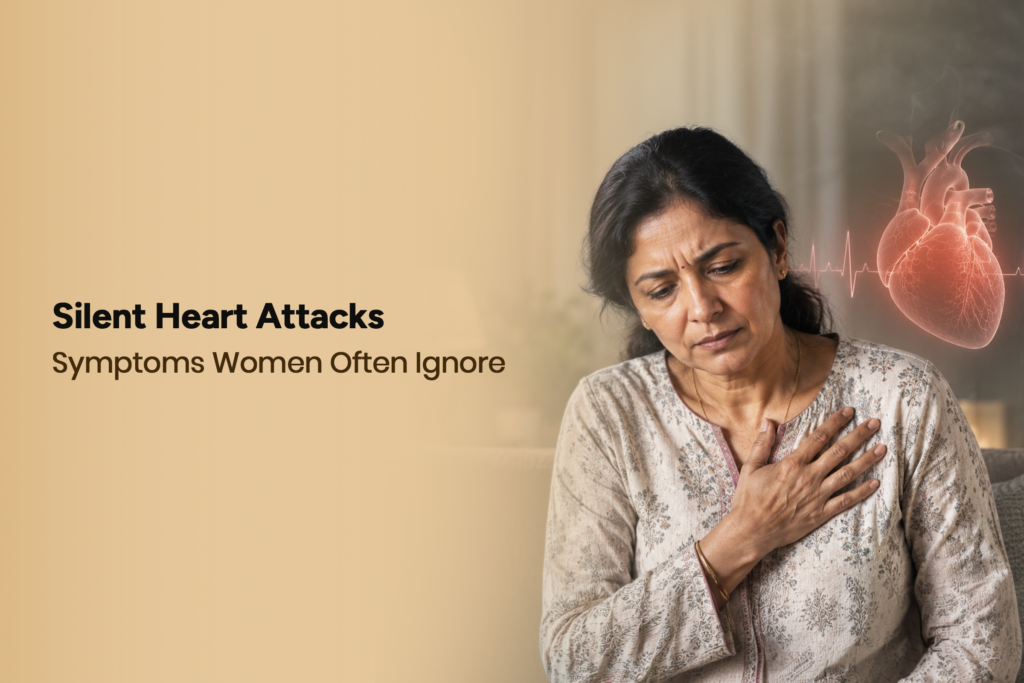
Silent Heart Attacks: Symptoms Women Often Ignore
We are all familiar with the classic movie scene depicting a heart attack. A man clutches his chest in severe agony, gasps for air, and collapses to the floor. While crushing chest pressure is a genuine medical emergency, real life is rarely that dramatic, especially for women.
In reality, a heart attack does not always announce itself with intense pain. It can slip in quietly, disguised as mild fatigue, indigestion, or a nagging backache. These are known as silent heart attacks, or silent myocardial infarctions.
Because the signs are so subtle, women often brush them off as everyday stress, aging, or simple exhaustion. Delaying care during a heart event can lead to permanent heart damage or life-threatening complications. Understanding silent heart attack symptoms and recognizing how a heart attack in women presents physically is one of the most vital steps you can take for your long-term health.
What is a Silent Heart Attack?
A heart attack occurs when blood flow to a portion of the heart muscle is severely reduced or blocked completely. This blockage usually happens when plaque inside a coronary artery breaks open, forming a blood clot that restricts oxygen-rich blood from reaching the heart.
In a typical heart attack, this oxygen deprivation causes severe, unbearable chest pain. In a silent heart attack, the flow of blood is reduced or temporarily blocked, but the pain is mild, short-lived, or felt in unexpected parts of the body. You might not feel chest pain at all. As a result, many women go through a silent heart attack without realizing what happened, only discovering the permanent heart scarring months or years later during a routine electrocardiogram (ECG) or heart scan.
Why Women Experience Atypical Heart Attack Symptoms
Heart disease is often mistakenly viewed as a condition that primarily affects men. This misconception leads many women to overlook their own personal risk factors.
Physiologically, women’s blood vessels and heart structures differ from men’s in subtle ways:
- Microvascular Disease: Men often suffer blockages in their major coronary arteries. Women are more likely to develop disease in the smaller blood vessels that branch off from the main arteries, a condition known as coronary microvascular disease.
- Diffused Pain Pathways: Because microvascular disease affects smaller vessels, the distress signals sent to the brain are broader and less localized, leading to atypical chest pain or discomfort in the back, jaw, or stomach instead of central chest tightness.
- Hormonal Influences: Estrogen plays a protective role in keeping blood vessels flexible. As women transition through menopause and estrogen levels drop, cardiovascular risks increase sharply.
These biological differences mean that women’s heart health requires a completely different approach to recognizing cardiac warning signs.
Silent Heart Attack Symptoms Women Often Ignore
When a silent heart attack occurs, your body sends out subtle warning signals. Because women are often balancing busy careers, household responsibilities, and family caregiving, they frequently minimize these physical changes.
Here are the primary silent heart attack symptoms that every woman should know:
Unusual, Overwhelming Fatigue
Feeling tired after a long work week is normal. Feeling completely drained after simple tasks, such as making a bed, walking to the kitchen, or picking up light groceries, is not. If you experience a sudden, heavy exhaustion that lasts for days without a clear explanation, your heart muscle may be struggling to pump blood against a blocked artery.
Unexplained Shortness of Breath
If you suddenly find yourself gasping for air while sitting quietly, reading a book, or walking up a few steps, take notice. Shortness of breath can occur with or without chest discomfort during a silent heart attack. When the heart cannot pump blood efficiently, fluid can back up into the lungs, making breathing uncomfortable or difficult.
Pain in the Jaw, Neck, Throat, or Upper Back
The nervous system routes pain signals from the heart through the same spinal nerves that connect to your neck, jaw, shoulders, and upper back. Women having a silent heart attack frequently report a dull, heavy ache between their shoulder blades or a tight, pressure-like sensation in their lower jaw and throat. This discomfort can come and go or grow stronger over several hours.
Stomach Discomfort, Indigestion, and Nausea
It is very easy to dismiss early heart distress as acid reflux, stomach gas, or a mild case of food poisoning. You may experience unexplained nausea, abdominal cramping, or a burning sensation in your upper stomach that does not go away after taking antacids. If stomach discomfort appears alongside lightheadedness or cold sweats, treat it as a potential heart emergency.
Sudden Cold Sweats and Flushing
Breaking out in a cold, clammy sweat when you are not exercising and the room is not warm is a red flag. When your heart is struggling, your body activates its fight or flight mechanism, causing your nervous system to trigger sudden sweating, clammy skin, and flushing.
Comparing Classic vs. Silent Symptoms in Women
To help you visualize how these symptoms present differently in everyday life, let us examine a side by side comparison:
Symptom Category | Classic Heart Attack | Silent / Atypical Presentation in Women |
Chest Sensation | Crushing pressure, heavy squeezing, severe pain. | Mild tightness, brief burning, or no chest discomfort at all. |
Pain Spread | Sharp pain traveling dramatically down the left arm. | Dull, nagging ache in the upper back, lower jaw, neck, or shoulders. |
Stamina & Breathing | Immediate gasping for air alongside severe chest pain. | Sudden, heavy fatigue during basic movement; unexplained breathlessness. |
Systemic Signs | Sudden physical collapse or severe distress. | Clammy skin, unexplained cold sweats, persistent nausea, or lightheadedness. |
Specific Risk Factors for Women
While traditional risk factors like smoking, high blood pressure, high cholesterol, and a sedentary lifestyle affect everyone, women face unique health factors that raise their risk of a silent heart attack:
- Pregnancy Complications: A history of preeclampsia, gestational hypertension, or gestational diabetes during pregnancy increases a woman’s risk of heart disease later in life.
- Hormonal Conditions: Conditions like Polycystic Ovary Syndrome (PCOS) can lead to insulin resistance, weight gain, high blood pressure, and elevated cholesterol, all of which strain the cardiovascular system.
- Autoimmune Diseases: Conditions such as rheumatoid arthritis and lupus affect women far more frequently than men. Chronic systemic inflammation damages blood vessel linings and accelerates plaque build-up.
- Emotional Stress and Depression: High levels of chronic emotional stress or depression can cause blood vessels to constrict, elevating blood pressure and increasing heart attack risk.
When to See a Cardiologist: Taking Action Early
Knowing when to see a cardiologist can save your life. You do not need to wait for a full-blown medical crisis to evaluate your heart health.
You should schedule a consultation with a heart specialist if you:
- Experience recurring, unexplained episodes of breathlessness, lightheadedness, or upper body discomfort.
- Have a family history of early heart disease, stroke, or high blood pressure.
- Are transitioning through menopause and manage chronic conditions like diabetes or high blood pressure.
- Notice that routine daily activities leave you unusually exhausted or weak.
If you suspect you are experiencing an active silent heart attack, do not wait to see if the feelings pass. Stop all physical activity, rest comfortably, and seek emergency medical assistance immediately.
Advanced Heart Diagnostics: Getting Clear Answers
When you visit a specialized medical center with suspected cardiac distress, specialists do not guess. They rely on high-precision diagnostic tools to map your cardiovascular system and evaluate your heart function.
Electrocardiogram (ECG)
An ECG records the electrical signals generated by your heart. It can instantly show whether your heart rate is normal, whether a heart attack is currently happening, or if past damage has left electrical scarring on the heart muscle.
Cardiac Troponin Blood Tests
When heart cells suffer damage from a lack of oxygen, they leak specific proteins called troponins into your bloodstream. A rapid blood test measuring troponin levels gives doctors clear chemical proof of heart muscle distress.
Echocardiography (Echo)
An echocardiogram uses sound waves to generate detailed, live images of your heart’s chambers, valves, and pumping movement. It allows cardiologists to watch how well your heart muscle contracts and spot specific areas that are moving poorly due to reduced blood flow.
Treadmill Stress Testing (TMT)
For women who experience intermittent symptoms during physical movement, a treadmill test tracks heart function while walking under a controlled workload, revealing circulation issues that do not show up while resting.
Coronary Angiography and Cath Lab Interventions
If a significant blockage is detected, specialists use a specialized Cardiac Catheterization Laboratory (Cath Lab). A thin catheter is guided through a blood vessel to the heart, where contrast dye is injected to highlight blocked passages on live X-rays. If a clot is found, specialists can perform an angioplasty, inflating a tiny balloon to clear the artery and placing a mesh wire tube (stent) to keep the vessel open permanently.
Complete Cardiac Care: SMV Super Speciality Hospital
When dealing with a potential cardiac issue, having access to comprehensive medical infrastructure makes a tremendous difference. If you are searching for a trusted cardiology hospital in Puducherry or need to consult an experienced heart specialist in Puducherry, SMV Super Speciality Hospital provides the diagnostic tools and clinical expertise needed to protect your health.
As Puducherry’s first complete multi-specialty medical center, the hospital is built around a clear commitment: combining modern medical technology with top specialists to deliver clear answers, honest advice, and effective treatment plans. Under the leadership of Founder, Chairman, and Managing Director M. Dhanasekaran, the facility operates under a strict framework of 37 integrated international Standard Operating Procedures (SOPs) to ensure clinical precision and patient safety.
Full Infrastructure for Critical Care
The hospital’s medical campus is fully built to manage complex cardiovascular treatments and emergency situations:
- Puducherry’s Premier Complete Multi-Specialty Center
- 400+ Patient Beds & 80+ Dedicated ICU Beds
- 24×7 High-Precision Emergency & Trauma Care
- State-of-the-Art Cath Lab & 7 Modular Operation OTs
- Advanced 1.5T MRI, CT Scan & Digital X-Ray Support
To support recovering heart patients, the hospital features a dedicated 20-bed Cardiac ICU where critical care teams monitor patient vitals constantly around the clock. The emergency department operates 24×7, backed by rapid ambulance services, an in-house pharmacy, and a fully stocked blood bank to ensure immediate response during a crisis.
The Centre of Excellence in Cardiac Sciences
The hospital’s Centre of Excellence in Cardiac Sciences is anchored by experienced clinical specialists like Dr. Ashida (Cardiology). The department provides expert care across the full spectrum of heart conditions, including sudden emergencies, preventive cardiology, and long-term heart management.
- Comprehensive Non-Invasive Diagnostics: Patients have access to complete testing on campus, including Echocardiography (Echo), Electrocardiograms (ECG), functional Treadmill Tests (TMT), and continuous Holter Monitoring.
- Advanced Surgical Facilities: The hospital features 7 major modular operation theatres equipped with HEPA filtration and laminar airflow systems, alongside a modern Cath Lab for precise interventional cardiology procedures.
- Multi-Specialty Coordination: Because heart health in women is often linked to other conditions like diabetes or blood pressure variations, the cardiology team collaborates directly with internal medicine specialists (such as Dr. Clinton Ponraj), neurology experts (Dr. Anandh), and radiology units to manage your health safely. For local families seeking specialized cardiac care in Puducherry, this integrated framework ensures expert support from diagnosis through recovery.
Protecting Your Heart: Proactive Steps for Women
You do not have to wait for symptoms to appear before taking control of your cardiovascular health. Making intentional lifestyle choices significantly lowers your risk of experiencing a silent heart attack.
Schedule Regular Health Screenings
Regular health evaluations are the most effective way to identify hidden cardiovascular risks before they cause physical damage. Booking a comprehensive heart checkup in Puducherry or selecting a dedicated screening package, such as a Cardiac Health Screening, Women’s Wellness Package, or Executive Health Check, gives you clear insight into your blood pressure, lipid profile, and sugar levels.
Embrace a Heart-Healthy Lifestyle
- Eat Nutrient-Dense Foods: Focus on a diet rich in fresh vegetables, fruits, whole grains, lean proteins, and healthy fats like olive oil and nuts. Minimize processed foods, excess sodium, and refined sugars.
- Stay Physically Active: Aim for at least 150 minutes of moderate exercise every week, such as brisk walking, swimming, or cycling. Regular physical movement keeps blood vessels flexible and strengthens your heart muscle.
- Manage Stress Effectively: Incorporate stress-reduction techniques into your routine, such as deep breathing exercises, yoga, meditation, or spending time outdoors.
- Avoid Tobacco and Limit Alcohol: Smoking damages blood vessel linings and sharply increases blood clotting risks. Quitting tobacco is one of the most powerful actions you can take for your heart.
Conclusion: Listen to Your Body
Your heart works quietly every second of every day to keep you healthy, active, and present for the people you love. When it experiences distress, it relies on you to pay attention to its subtle signals.
Never make the mistake of brushing off persistent fatigue, strange jaw aches, unexplained breathlessness, or stomach discomfort as simple signs of stress or aging. By recognizing silent heart attack symptoms and understanding how a heart attack in women presents, you empower yourself to take life-saving action when it matters most.
Prioritize your health, listen to what your body is telling you, and build a relationship with a clinical team you can trust. By choosing proactive health screenings and expert care, you protect your heart, your vitality, and your peace of mind.