




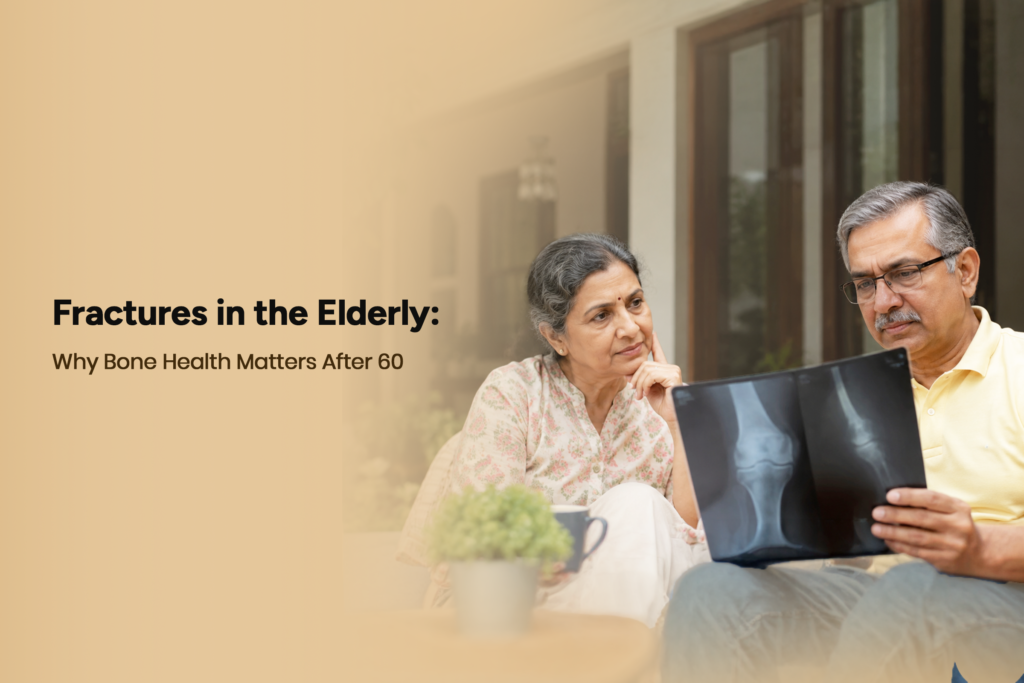
Fractures in the Elderly: Why Bone Health Matters After 60
Growing older brings wisdom, cherished family milestones, and the freedom to enjoy life at your own pace. However, our bodies naturally undergo physical changes as the years go by. One of the most significant yet unseen shifts happens deep inside our skeleton. Bones that were once dense and sturdy can quietly become thin, fragile, and porous.
For adults over the age of 60, a minor slip on a wet bathroom floor, a misstep on a curb, or even a sudden twist can result in a serious bone break. While a younger person might bounce back from a fall with just a few bruises, a broken bone in an older adult can suddenly alter daily independence, mobility, and overall quality of life.
Understanding the importance of bone health, taking steps toward fall prevention, and knowing what modern options exist for fracture treatment elderly patients need are essential for preserving lifelong vitality. Let us look into how our bones change after 60, why senior fractures happen, and how specialized orthopaedic care helps seniors stay active and independent.
The Silent Biology: What Happens to Bones After 60?
To understand why fractures become more common as we age, it helps to see how living bone tissue behaves throughout life. Bone is not hard, unchanging rock; it is living tissue that continuously breaks down old cells and replaces them with new bone material.
During childhood and early adulthood, your body builds new bone faster than it breaks down old bone. Around age 30, most people reach their peak bone mass. After this point, the natural balance slowly reverses. As we enter our 50s and 60s, bone breakdown begins to outpace bone replacement.
This gradual loss of bone density often leads to osteopenia and, eventually, osteoporosis.
- Osteoporosis: A condition where the internal honeycomb structure of bone develops large gaps, making the bone brittle and prone to breaking under minor stress.
- Hormonal Changes: In women, the sharp drop in estrogen after menopause accelerates bone density loss. In men, gradual drops in testosterone contribute to progressive bone thinning.
- Reduced Nutrient Absorption: As the digestive system ages, the body absorbs less dietary calcium and vitamin D, both of which are critical for maintaining mineralized bone strength.
Because bone thinning happens quietly without causing pain, many seniors do not realize their bones have weakened until a sudden fracture occurs.
The Most Common Fractures in Older Adults
When a fall happens, certain bones in the senior body are particularly vulnerable due to how weight and impact are transferred during an accident.
Hip Fractures
A hip fracture is one of the most serious injuries an older adult can experience. It typically occurs at the top of the thigh bone (femur) near the hip joint. Because walking and weight-bearing rely heavily on this joint, a hip fracture usually requires immediate surgical stabilization to prevent prolonged bed rest and related health complications.
Vertebral Compression Fractures (Spine)
Weakened bones in the spine can collapse under normal body weight or during everyday movements like bending forward, lifting a grocery bag, or coughing. Over time, multiple tiny compression fractures can cause a curved upper back (often called a dowager’s hump), loss of height, and persistent back pain.
Wrist and Forearm Fractures (Colles’ Fracture)
When someone slips, the natural reflex is to reach out with an open hand to break the fall. The sudden impact forces all the body weight onto the fragile wrist bones, frequently causing the lower end of the radius bone to crack or shatter.
Pelvis and Shoulder Fractures
Direct impacts to the side of the body during a fall can cause fractures in the pelvic ring or the top of the arm bone (humerus), resulting in severe bruising and restricted movement.
Comparing Healthy Bone vs. Osteoporotic Bone
To help you visualize why broken bones happen so easily in seniors, let us take a side by side look at how bone structure and injury risks compare:
Bone Characteristic | Healthy Young Adult Bone | Aging / Osteoporotic Bone (After 60) |
Internal Structure | Dense, thick, and closely knit mineral network. | Thin, brittle, and wide honeycomb gaps with low density. |
Impact Resistance | Absorbs high-energy falls and impacts without breaking. | Can fracture from low-energy slips, minor twists, or bumps. |
Healing Timeline | Rapid natural healing with strong callus formation. | Slower healing, requiring careful stabilization and support. |
Accompanying Risks | Low risk of systemic complications during recovery. | Higher risk of muscle weakness, stiffness, and blood clots. |
Why Fractures Are Dangerous for Seniors
A broken bone after 60 is more than just an orthopaedic injury; it impacts the whole body. The main danger of a senior fracture comes from the loss of mobility that follows.
When an older adult is confined to bed for several weeks, they face serious health risks:
- Muscle Loss (Sarcopenia): Seniors can lose significant leg muscle mass within just a few days of complete bed rest, making it harder to walk again later.
- Chest Infections: Remaining in a flat position reduces lung expansion, increasing the risk of respiratory infections and pneumonia.
- Blood Clots: Slowed circulation increases the likelihood of deep vein thrombosis (DVT) in the legs, which can travel to the lungs.
- Loss of Independence: The fear of falling again after an injury can lead to social isolation, anxiety, and a sudden decline in confidence.
This is why modern geriatric orthopedic care prioritizes rapid surgical treatment and early movement to get senior patients out of bed and walking as soon as possible.
Fall Prevention for Seniors: Protecting Your Home
The most effective fracture treatment is stopping the fall before it happens. Most senior falls occur inside the home during routine daily activities. Making a few simple adjustments to living spaces can dramatically lower accident risks.
Essential Home Safety Steps
- Remove Tripping Hazards: Pick up loose throw rugs, secure electrical cords along walls, and keep hallways free of clutter.
- Upgrade Bathroom Safety: Install sturdy grab bars inside showers and beside toilets. Place rubber non-slip mats inside bathing areas and ensure floors remain dry.
- Improve Indoor Lighting: Keep stairways, hallways, and bedrooms brightly lit. Place nightlights in paths leading from the bed to the bathroom.
- Wear Supportive Shoes: Avoid walking around the house in smooth socks or loose backless slippers. Choose supportive, non-slip footwear with low heels.
- Review Daily Medications: Some medications for blood pressure, sleep, or anxiety can cause sudden dizziness or drowsiness. Ask your doctor to review your prescriptions regularly.
- Schedule Vision Checks: Keep your eye prescription up to date so you can spot steps, curbs, and floor transitions clearly.
Modern Fracture Treatment for the Elderly
When a fracture occurs, prompt medical evaluation determines the best path to recovery. Depending on the location and severity of the break, treatment options range from supportive casting to advanced reconstructive surgery.
Non-Surgical Care (Casting and Bracing)
For stable, non-displaced fractures of the wrist, shoulder, or small bones, doctors may use lightweight fiberglass casts, splints, or functional braces. These hold the bone fragments securely in place while the body’s natural healing process repairs the break over six to eight weeks.
Surgical Realignment (Internal Fixation)
If a bone has broken into multiple pieces or moved out of alignment, surgery is needed to restore stability. An orthopaedic surgeon uses biocompatible titanium plates, screws, or metal rods inside the bone marrow to lock the fragments together. This internal scaffolding allows the bone to heal in the correct position and enables early gentle movement.
Hip Fracture Surgery and Joint Replacement
For severe hip breaks, doctors may perform a partial or total hip replacement, removing the damaged bone and replacing it with modern metal and ceramic joint implants. High-precision hip fracture surgery restores joint stability immediately, often allowing the patient to stand and take supported steps with a walker within 24 to 48 hours after surgery.
Vertebroplasty and Kyphoplasty (Spine Care)
For painful spinal compression fractures that do not heal with rest, minimally invasive procedures like vertebroplasty can help. A doctor inserts a small needle into the collapsed vertebra under live X-ray guidance and injects medical-grade bone cement. This stabilizes the bone, restores height, and provides rapid pain relief.
Comprehensive Orthopaedic Care: SMV Super Speciality Hospital
Managing fractures in older adults requires an integrated medical setup that combines surgical precision with gentle, comprehensive care. For families looking for a trusted orthopaedic hospital in Puducherry or searching for an experienced orthopedic doctor in Puducherry, SMV Super Speciality Hospital is equipped to deliver timely, high-precision care for senior bone health.
As Puducherry’s first complete multi-specialty medical center, the hospital provides clear answers, honest advice, and the right treatment pathways under one roof. Under the leadership of Founder, Chairman, and Managing Director M. Dhanasekaran, the facility follows 37 integrated international Standard Operating Procedures (SOPs) to guarantee clinical precision and patient safety across every department.
Full Infrastructure for Senior Trauma and Recovery
The hospital’s medical campus is built to handle complex geriatric trauma cases and post-surgical rehabilitation:
- Puducherry’s Premier Multi-Specialty Care Center
- 400+ Patient Beds & 80+ Dedicated ICU Beds
- 24×7 Emergency Trauma & Ambulance Response Network
- 7 Major Modular Operation Theatres with Laminar Air
- Advanced 1.5T MRI, Fast CT Scan & Digital X-Ray Labs
The hospital’s 24×7 emergency and trauma care unit operates around the clock, backed by rapid ambulance services, an in-house pharmacy, and a fully stocked blood bank to stabilize senior patients quickly during an emergency.
Centre of Excellence in Orthopaedics
The hospital’s Centre of Excellence in Orthopaedics, Joint Replacement and Sports Injury Care is anchored by experienced clinical specialists like Dr. Boobathi Raja and Dr. Ganesh. The team focuses on treating injuries safely and helping patients regain their mobility:
- Fracture and Trauma Management: Expert care for hip fractures, complex joint breaks, and osteoporosis-related bone injuries using modern surgical techniques.
- Joint Replacement Program: High-precision hip and knee replacements performed in 7 major modular operation theatres equipped with HEPA filtration and laminar airflow systems to ensure maximum sterile safety.
- Spine Care Unit: Comprehensive diagnosis and care for spinal compression fractures, disc issues, and degenerative spine conditions.
- Advanced Radiology Support: On-site digital X-rays, high-speed CT scans, and a 1.5T MRI system allow specialists to identify hidden hairline fractures and evaluate bone density with accuracy.
Multi-Specialty Support for Seniors
Older adults with bone fractures often manage other chronic health conditions like high blood pressure, diabetes, or heart disease. The orthopaedic team works directly with internal medicine specialists (such as Dr. Clinton Ponraj), cardiology experts (Dr. Ashida), and critical care teams. For residents seeking a dedicated bone and joint hospital in Puducherry, this coordinated setup ensures that every aspect of an elderly patient’s health is managed safely from admission to recovery.
Rebuilding Bone Health: Actionable Steps After 60
Protecting your bones is a lifelong commitment, but it is never too late to rebuild strength and lower your osteoporosis fracture risk.
Ensure Adequate Calcium and Vitamin D
- Calcium: Aim for around 1,200 mg of calcium daily through foods like milk, curd, paneer, ragi, sesame seeds, almonds, and dark leafy greens.
- Vitamin D: Vitamin D is essential for absorbing calcium into your bones. Spend 15 to 20 minutes in morning sunlight daily, and ask your doctor if you need a vitamin D supplement.
Engage in Safe Weight-Bearing Exercises
Bones respond to physical effort by growing denser. Low-impact weight-bearing activities stimulate bone-building cells without stressing fragile joints:
- Daily brisk walking or light stair climbing.
- Gentle strength exercises using light hand weights or resistance bands.
- Balance training like yoga, tai chi, or heel-to-toe walking to improve stability and prevent falls.
Schedule Bone Density Screenings
A dual-energy X-ray absorptiometry (DEXA) scan is a quick, painless test that measures mineral density in your hips and spine. It helps doctors detect osteopenia or osteoporosis early so they can prescribe bone-strengthening medications before a break happens.
Choose Preventive Health Screenings
Booking a regular health checkup in Puducherry or selecting a dedicated preventive package, such as a Senior Citizen Health Package or an Executive Health Check, helps you track your bone health, joint mobility, blood sugar, and vitamin levels under professional medical supervision.
Conclusion: Protect Your Mobility and Independence
Your bones carry you through every experience in life. When bone density declines after 60, acknowledging these physical changes is the first step toward staying safe, active, and mobile.
Never dismiss a sudden fall or persistent bone ache as an unavoidable part of aging. By making your home fall-safe, staying active with gentle exercise, nourishing your skeleton, and seeking timely medical care when accidents occur, you can protect your bones for years to come.
Stay proactive with your bone health, schedule routine checkups, and partner with a trusted orthopaedic team that treats you with clarity, precision, and respect. With the right support and care, you can maintain your strength, protect your independence, and enjoy a vibrant life.