




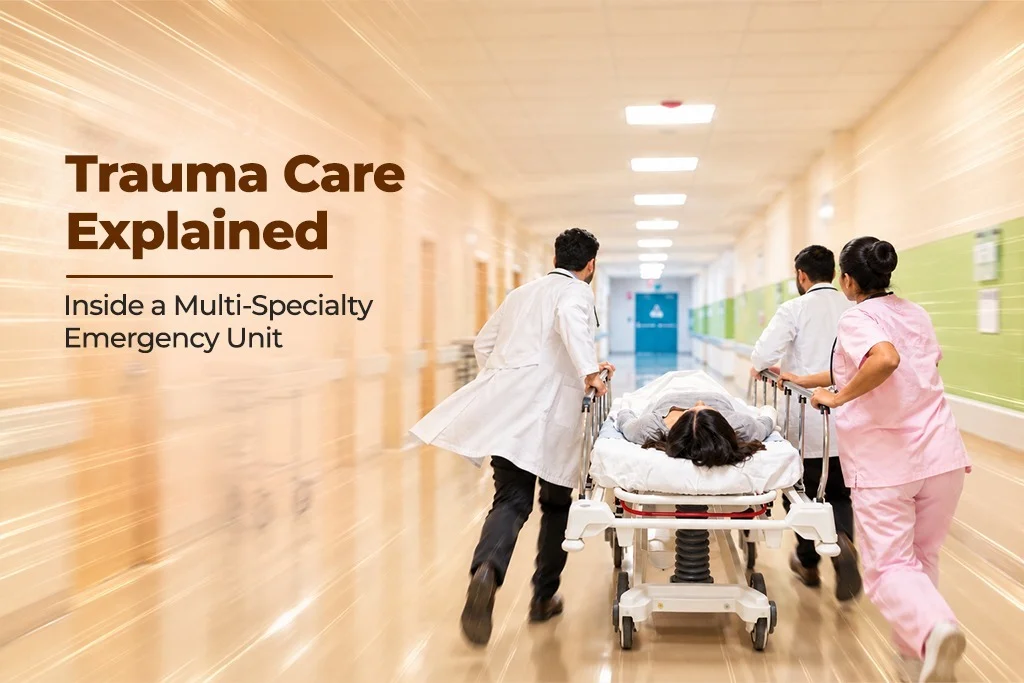
Trauma Care Explained: Inside a Multi-Specialty Emergency Unit
Accidents and severe medical crises never arrive with an advance warning. A quiet ride along the East Coast Road, an unexpected slip at home, or a workplace mishap can change everything in seconds. When severe injury strikes, the ordinary rhythm of life stops, and the clock begins ticking with fierce urgency.
In those first intense moments, the place where you take the injured person decides everything. A standard medical clinic can manage minor cuts or fevers, but severe injuries demand an entirely different level of medical preparedness. You need a dedicated trauma care hospital designed from the ground up to fight shock, halt massive bleeding, and repair damaged organs without losing a second.
Stepping into a modern emergency bay can look like controlled chaos to an outsider. Yet, behind the bright lights, rapid movements, and beeping monitors lies a carefully organized clinical machine. Every specialist, nurse, and technician moves with exact purpose under strict life-saving protocols.
Understanding what happens inside a multi-specialty emergency unit, how trauma teams work, and why rapid surgical access saves lives can help you make the right choice when an emergency occurs. Let us walk through the doors of a modern trauma center to see how advanced emergency medicine protects human life.
What is Trauma Care?
In medicine, the word trauma does not refer to emotional distress; it refers to severe, sudden physical damage caused by an external force.
Trauma injuries can result from:
- High-impact motor vehicle collisions on busy highways.
- Severe falls from heights, scaffolding, or stairways.
- Penetrating injuries from machinery, sharp objects, or construction tools.
- Crush injuries from structural collapses or industrial accidents.
- Polytrauma, where a patient suffers multiple injuries across different body systems simultaneously, such as a broken femur, a ruptured spleen, and a head injury.
A routine emergency room handles a broad mix of health problems, from food poisoning to asthma flare-ups. In contrast, a specialized trauma unit is engineered for acute resuscitation. It features instant access to surgical suites, in-house blood banks, advanced diagnostic imaging, and an on-call team of surgeons ready to operate immediately.
The Concept of Trauma Centers: What Sets Them Apart?
Emergency medicine classifies trauma care facilities into structured tiers based on their resources, surgical availability, and clinical capabilities. Understanding these differences helps families appreciate the level of care their loved ones receive.
The Benchmark: A Level 1 Trauma Center
A facility operating at the level of a level 1 trauma center represents the gold standard of emergency medicine. Key requirements include:
- Total Surgical Readiness: Immediate 24×7 availability of in-house trauma surgeons, orthopaedic surgeons, neurosurgeons, plastic surgeons, and anesthesiologists.
- Comprehensive Diagnostic Equipment: On-site 1.5T MRI systems, ultra-fast CT scanners, digital X-rays, and point-of-care ultrasound machines ready right next to the resuscitation bays.
- Dedicated Critical Care Networks: Immediate bed availability in specialized trauma, surgical, and neuro intensive care units.
- Community Leadership and Outreach: Active programs in disaster response, trauma education, and community injury prevention.
When an ambulance pulls up to a high-tier trauma center, the hospital does not spend time looking for on-call doctors. The team is already prepped and waiting at the bay before the ambulance arrives.
Inside the Multi-Specialty Emergency Unit: The First 15 Minutes
The survival of a trauma patient depends on the actions taken during the initial minutes after arrival. Here is a step-by-step look at how a multi-specialty trauma unit handles a critical arrival.
Rapid Triage
Not all injuries carry the same urgency. The moment the stretcher enters the doors, specialized triage nurses categorize the patient:
- Red Zone (Resuscitation): Patients with blocked airways, severe breathing distress, heavy bleeding, or coma. They bypass administrative paperwork and go straight to the resuscitation bay.
- Yellow Zone (Urgent): Patients with stable fractures, moderate burns, or deep lacerations that require prompt care but are not immediately life-threatening.
- Green Zone (Non-Urgent): Walking wounded with minor sprains or abrasions.
The ABCDE Protocol (The Primary Survey)
In the Red Zone, the trauma team follows a strict, time-tested checklist known worldwide as the ABCDE approach:
- A: Airway with Cervical Spine Protection: The team ensures the breathing tube is clear of blood, vomit, or broken teeth. A rigid cervical collar protects the neck from movement to prevent spinal cord injury.
- B: Breathing and Ventilation: Doctors check if both lungs are expanding equally. If a punctured lung creates air pressure inside the chest (tension pneumothorax), a chest tube is inserted immediately to relieve pressure.
- C: Circulation and Bleeding Control: Active bleeding is stopped using direct pressure, specialized clamps, or tourniquets. Two large IV lines are inserted to infuse warming fluids and emergency blood.
- D: Disability and Neurological Evaluation: The team checks pupil response and uses the Glasgow Coma Scale (GCS) to assess brain function.
- E: Exposure and Environmental Control: The patient’s clothing is carefully cut away to reveal any hidden wounds on the back, pelvis, or limbs, while warm blankets protect against hypothermia.
The Critical Care Team: Who Rushes to Your Side?
In a high-intensity trauma scenario, a single doctor cannot handle everything. A true multi-specialty trauma unit relies on a multidisciplinary critical care team where each specialist carries out an exact assignment.
- Trauma Team Leader: Typically an experienced emergency medicine physician or general trauma surgeon who stands at the foot of the bed, observing the whole picture, coordinating the team, and making quick decisions.
- Airway Specialist (Anesthesiologist): Positioned at the head of the bed, this expert secures the airway, administers medications, and manages mechanical ventilation.
- Orthopaedic Trauma Surgeon: Assesses joint dislocations, pelvic fractures, and broken limb bones, applying traction or external fixators to stop internal blood pooling around large fractures.
- Neurosurgeon: Steps in immediately if there is bleeding inside the skull, brain swelling, or spine fractures.
- Trauma Nurses: Administer emergency medications, draw blood for crossmatching, hook up heart monitors, and maintain clear records of vital signs.
- Radiographers and Blood Bank Staff: Run bedside X-rays, ultrasound checks, and rapid crossmatching to deliver universal blood units within minutes.
Comparing General Emergency Rooms vs. Advanced Trauma Centers
To help you understand why choosing the right center matters during an accident, let us look at how capabilities compare side by side:
Feature | Community Clinic / Basic ER | Dedicated Multi-Specialty Trauma Center |
Surgical Availability | Surgeons are on-call from home, taking 45 to 60 minutes to arrive. | Multi-specialty surgeons present on-site 24×7 for immediate intervention. |
Operating Theatres | Shared elective surgery rooms that must be cleared and cleaned first. | Dedicated emergency operation theatres maintained on constant standby. |
Diagnostic Access | Basic X-ray available; CT or MRI requires transferring the patient. | Bedside ultrasound, 1.5T MRI, and high-speed CT scans right beside trauma bays. |
Blood Bank Readiness | Limited stored blood; relies on external regional blood centers. | 24×7 in-house blood bank with rapid component separation (plasma, platelets). |
Intensive Care Setup | Small, mixed medical ICU with general nursing care. | Specialized trauma, neuro, surgical, and cardiac ICUs with dedicated critical care nurses. |
Emergency Surgery Services: When Minutes Determine Survival
In severe accidents, stabilizing the patient in the emergency bay is only the beginning. Uncontrolled internal bleeding in the chest or abdomen cannot be fixed with medicines or IV fluids; it requires immediate, skilled hands in an operating theatre.
A dedicated trauma center features round-the-clock emergency surgery services. The concept of “Damage Control Surgery” is a cornerstone of modern trauma care:
- Phase 1: Rapid Damage Control: The surgical team does not attempt lengthy, complex repairs while the patient is unstable. Instead, the surgeon opens the abdomen, packs bleeding areas, clamps severed vessels, closes hollow organ leaks, and covers the wound temporarily. This quick procedure takes less than an hour, stopping the loss of life-giving blood.
- Phase 2: ICU Stabilization: The patient is moved immediately to a specialized surgical or trauma ICU. Here, the team warms the body, restores normal blood clotting factors, and stabilizes blood pressure over the next 24 to 48 hours.
- Phase 3: Definitive Repair: Once the patient is warm, stable, and out of shock, the surgical team brings them back to the operating room for permanent bone alignment, tissue reconstruction, and definitive wound closure.
Complete Trauma and Emergency Care: SMV Super Speciality Hospital
When severe injury strikes, having access to an integrated multi-specialty medical center makes all the difference between recovery and permanent disability. For families, commuters, and travelers searching for the most reliable emergency hospital in Puducherry or a dependable trauma center in Puducherry, SMV Super Speciality Hospital delivers high-precision clinical care when every second counts.
As Puducherry’s first complete multi-specialty medical center, the hospital provides clear answers, honest medical advice, and effective treatment options under one roof. Under the leadership of Founder, Chairman, and Managing Director M. Dhanasekaran, the facility operates under a strict framework of 37 integrated international Standard Operating Procedures (SOPs) to guarantee clinical precision, patient dignity, and absolute safety.
Full Infrastructure for Accident and Trauma Treatment
The hospital’s vast medical campus is built to handle complex multi-trauma injuries, head trauma, and critical emergencies:
- Puducherry’s Premier Multi-Specialty Care Center
- 400+ Patient Beds & 80+ Dedicated ICU Beds
- 24×7 Emergency Trauma Unit & Rapid Ambulance Support
- 7 Major Modular Operation Theatres with Laminar Air
- Advanced 1.5T MRI, Fast CT Scan & Digital X-Ray Labs
The 24×7 emergency and trauma care unit operates around the clock, backed by advanced life-support ambulance services, an on-site 24×7 pharmacy, and a fully equipped blood bank to ensure rapid medical action during a crisis.
Centres of Excellence for Seamless Trauma Response
The hospital brings together experienced clinical specialists across every critical surgical discipline to manage polytrauma seamlessly:
- Trauma Care & Emergency Response: The structured trauma care system provides dedicated emergency operation theatres, critical care stabilization bays, and triage systems designed for rapid response.
- Centre of Excellence in Orthopaedics: Anchored by specialists like Dr. Boobathi Raja and Dr. Ganesh, the department delivers expert fracture management, joint stabilization, and complex orthopaedic trauma care.
- Centre of Excellence in Neuro Sciences: Under the clinical leadership of Dr. Anandh (Neurosurgery), the unit provides emergency evaluation and minimally invasive procedures for brain tumors, skull fractures, spinal cord injuries, and severe head trauma.
- Centre of Excellence in Cardiac Sciences: Led by experts like Dr. Ashida (Cardiology), the hospital features a high-precision Cath Lab and a dedicated 20-bed Cardiac ICU to manage heart trauma and emergency heart attacks immediately.
- Advanced Surgical Infrastructure: Surgeries take place across 7 major modular operation theatres fitted with HEPA filtration and laminar airflow systems to guarantee clean, infection-free surgical environments.
Coordinated Multi-Specialty Care
Because major accidents often affect internal organs, vascular networks, and metabolic balance, the emergency team collaborates directly with vascular surgery specialists (such as Dr. Subrayan), plastic surgery experts (Dr. Lakshmi), general surgeons (Dr. Pranab), and internal medicine consultants (Dr. Clinton Ponraj). For residents looking for an advanced hospital near me in Puducherry during a highway emergency, this integrated team provides complete clinical safety from admission to recovery.
Actionable Steps: What to Do While Waiting for Help
While a trauma hospital handles advanced medicine, the survival chain begins at the scene of the accident. How bystanders react in the first few minutes can save a life.
Ensure the Scene is Safe
Do not run into oncoming highway traffic or an unstable structure. Make sure the area is safe for you before approaching the injured person. Turn off vehicle ignitions if possible to prevent fires.
Call for an Advanced Ambulance Immediately
Call the hospital’s emergency line right away. Give clear details: your exact location, landmarks, the number of injured people, and whether anyone is unconscious or trapped.
Stop Severe Bleeding
Arterial bleeding can cause death in less than five minutes. Take a clean cloth, towel, or shirt, place it directly over the wound, and apply firm, steady pressure with both hands. Do not remove the cloth if blood soaks through; add more cloth on top and keep pressing.
Do Not Move the Neck or Spine
Unless there is an immediate threat of fire, explosion, or drowning, do not pull, twist, or drag an accident victim. Keep their head and neck aligned with their body. Rough movement of a broken neck can sever the spinal cord and cause permanent paralysis.
Never Offer Food or Water
An injured person may beg for water due to thirst caused by blood loss. Giving them water or food can cause choking or vomiting. If they need emergency anesthesia later, having fluids in their stomach creates severe risks during surgery.
Proactive Wellness: Protecting Family Health
While having access to a high-tier trauma center is vital during an accident, staying proactive about family wellness prevents medical emergencies from chronic diseases. Sudden collapses, strokes, and heart attacks often develop quietly from unmanaged high blood pressure, diabetes, or heart disease.
Booking a regular health checkup in Puducherry or selecting a dedicated screening package, such as an Executive Health Check, Comprehensive Health Check, or Diabetes & Lifestyle Assessment, gives you clear data to keep your body strong and resilient. Early screening helps doctors detect hidden cardiovascular vulnerabilities early, allowing you to protect your long-term vitality.
Conclusion: Hope and Precision in Critical Moments
Severe physical trauma is one of the most frightening challenges an individual or family can ever face. Yet, inside a modern multi-specialty trauma unit, fear is met with clinical precision, advanced technology, and calm expertise.
From the roadside ambulance call to the resuscitation bay, the operating theatre, and the specialized ICU, every step is built around saving life and restoring function. By understanding how trauma care works, keeping emergency helpline numbers saved on your phone, and choosing an integrated multi-specialty hospital, you give your loved ones the strongest possible safety net when it matters most.
Stay informed, practice safety on the road and at home, and trust in skilled emergency medicine to stand by your side during life’s most critical moments.