


Stroke Warning Signs: The FAST Method Everyone Should Know
Medical emergencies rarely give you advance notice, but few are as urgent or life-altering as an acute brain stroke. One moment you might be enjoying a meal with family or walking down the promenade along the scenic coast of Puducherry, and the next moment, someone nearby starts slurring their words or loses balance completely.
In everyday conversation, people often call a stroke a “brain attack.” Much like a heart attack cuts off oxygen to the heart muscle, a stroke suddenly cuts off blood flow and oxygen to the brain. When that happens, brain cells begin dying within minutes.
The single most powerful weapon against brain damage during a stroke is immediate action. Recognizing the early symptoms and acting without hesitation can mean the difference between a full recovery and lifelong physical disability.
This is where the simple, life-saving FAST framework comes into play. Remembering the stroke warning signs FAST helps anyone, regardless of medical background, identify an emergency and seek specialized neurological emergency care before it is too late.
This detailed guide explains what happens during a stroke, how to use the FAST method, the critical treatments available, and what steps you can take to protect your brain health.
What Happens During a Stroke?
Your brain is the command center of your body. It relies on a continuous, uninterrupted stream of oxygen and nutrients carried by blood vessels. When blood cannot reach brain tissue, the cells in that affected area cannot produce energy, leading to rapid cell death.
Doctors categorize strokes into two main types:
Ischemic Stroke
This is the most common form, accounting for roughly 85 percent of all cases. It occurs when a blood clot lodges inside an artery leading to or within the brain. The clot can form directly inside the narrowed brain artery or travel from elsewhere in the body, such as the heart.
Hemorrhagic Stroke
This happens when a weakened blood vessel in the brain ruptures or leaks, spilling blood into or around brain tissue. The accumulation of blood creates pressure on surrounding brain structures, causing tissue irritation and swelling. Chronic, uncontrolled high blood pressure is the leading cause of hemorrhagic strokes.
Transient Ischemic Attack (TIA)
Often called a “mini-stroke,” a TIA occurs when blood flow to the brain is briefly interrupted by a temporary clot. While the symptoms may clear within minutes or hours without permanent damage, a TIA is a severe warning sign. Up to one in three people who have a TIA experience a major stroke in the near future if the underlying condition is left untreated.
The FAST Method Explained: How to Spot a Stroke
When a stroke occurs, every single second counts. In emergency neurology, specialists say that “time is brain.” In fact, every single minute an acute stroke goes untreated, an estimated 1.9 million brain cells are lost permanently.
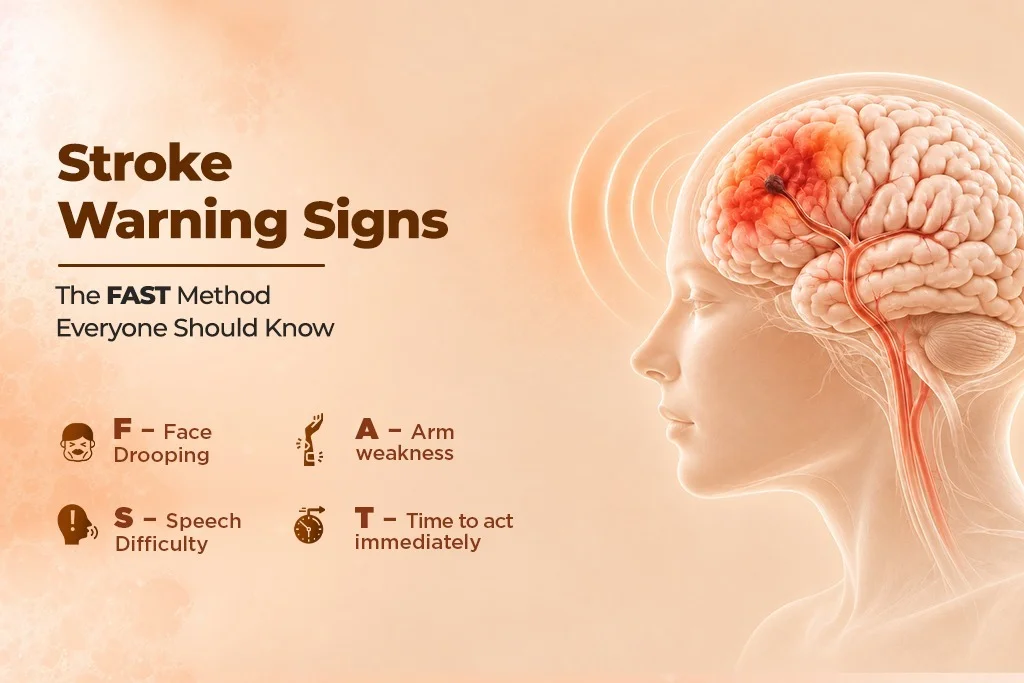
To help bystanders, family members, and coworkers spot a stroke instantly, emergency doctors developed the FAST method:
F: Face Drooping
Ask the person to smile. Does one side of their face droop or seem numb? Is their smile crooked or uneven? A sudden asymmetry around the mouth, cheek, or eyelids is one of the clearest early indicators of a neurological event.
A: Arm Weakness
Ask the person to raise both arms straight out in front of them with palms facing down. Does one arm drift downward or feel too heavy to lift? Sudden weakness or numbness affecting one side of the body, including the arm or leg, points toward a stroke.
S: Speech Difficulty
Ask the person to repeat a simple sentence, such as “The sky is blue today.” Can they repeat it accurately? Do their words sound slurred, garbled, or confused? A person having a stroke may struggle to find the right words or might not understand what you are saying to them.
T: Time to Call Emergency Care
If you notice any one of these signs, even if the symptoms fade away quickly, time is your top priority. Do not wait to see if things improve. Do not let the person sleep it off. Call emergency medical services immediately or rush to an advanced hospital with specialized stroke support. Note the exact time the symptoms started, as this determines which life-saving treatments doctors can use.
Additional Signs of Stroke in Adults
While the FAST method catches the vast majority of cases, a stroke can also present with other sudden brain attack symptoms. Being alert to these additional signs of stroke in adults gives you a broader safety net:
- Sudden Numbness on One Side: Unexpected tingling or complete loss of sensation in the face, arm, or leg, especially isolated to the right or left side.
- Vision Problems: Sudden blurriness, double vision, or complete blindness in one or both eyes.
- Loss of Balance and Coordination: Sudden dizziness, stumbling, trouble walking, or complete loss of equilibrium without an obvious cause.
- A “Thunderclap” Headache: A severe, blinding headache that hits suddenly like a strike of thunder with no known history of migraines. This is often associated with a hemorrhagic stroke.
- Mental Confusion: Sudden disorientation, trouble understanding simple conversations, or inability to respond to basic questions.
Comparing Ischemic and Hemorrhagic Strokes
To help you understand how the two primary forms of stroke differ, let us examine their features side by side:
Category | Ischemic Stroke | Hemorrhagic Stroke |
Basic Cause | Artery blocked by a blood clot, starving tissue of oxygen. | Weakened artery bursts, spilling blood into brain tissue. |
Overall Frequency | Makes up roughly 85% of all stroke cases. | Makes up roughly 15% of all stroke cases. |
Typical Onset | Often painless; sudden numbness, drooping, or speech trouble. | Frequently accompanied by a sudden, blinding headache and nausea. |
Primary Risk Factor | High cholesterol, carotid artery disease, diabetes, smoking. | Uncontrolled high blood pressure, aneurysms, blood thinners. |
First-Line Treatment | Clot-busting medications (thrombolysis) or mechanical clot removal. | Surgical repair, blood pressure lowering, and pressure relief. |
Immediate Diagnostic Test | Rapid non-contrast brain CT scan to rule out bleeding. | Rapid brain CT or MRI to locate the bleed and measure volume. |
The Golden Window: Stroke Emergency Treatment
When a stroke occurs, receiving medical care inside a specialized stroke emergency treatment unit is essential. Just as in severe heart attacks or road trauma, acute stroke management operates within a strict “Golden Window.”
Rapid Diagnostic Imaging
The very first step upon reaching the emergency room is an immediate brain scan, usually a high-speed CT scan. A doctor cannot treat a stroke until they know whether it is caused by a clot (ischemic) or a bleed (hemorrhagic), because treatments for one can be fatal for the other.
Intravenous Thrombolysis (Clot-Busting Drugs)
For an ischemic stroke, doctors can inject a powerful clot-dissolving medication called Tissue Plasminogen Activator (tPA). To be effective and safe, this medication must be administered within 3 to 4.5 hours from the exact moment symptoms began. It works by breaking down the clot, restoring blood flow, and rescuing brain tissue that was starving of oxygen.
Mechanical Thrombectomy (Endovascular Clot Retrieval)
If a large blood vessel inside the brain is blocked, clot-dissolving medications alone might not be enough. In these cases, interventional neurosurgeons perform a minimally invasive procedure called mechanical thrombectomy. Using a thin catheter inserted through a blood vessel in the groin or wrist, specialists guide a tiny retriever up to the brain to physically pull the clot out. This procedure can be performed up to 6 to 24 hours after symptom onset in carefully selected patients.
Emergency Neurosurgical Care for Hemorrhagic Strokes
If a blood vessel has ruptured, doctors work quickly to lower blood pressure, stop medications that promote bleeding, and relieve intracranial pressure. In severe cases, a neurosurgeon may perform an emergency craniotomy to remove pooled blood and repair the damaged vessel or aneurysm.
The Stroke Recovery Process: Rebuilding Independence
Surviving an acute stroke is the initial step; the next journey is rehabilitation. The stroke recovery process varies from person to person depending on which area of the brain was affected and how quickly treatment was delivered.
Thanks to a biological ability called neuroplasticity, the brain can reorganize itself, creating new neural pathways around damaged areas to relearn lost skills.
Key Elements of Stroke Rehabilitation:
- Physical Therapy (PT): Helps restore movement, balance, and muscle strength. Physical therapists work with patients to stand, walk, climb stairs, and regain limb control.
- Occupational Therapy (OT): Focuses on everyday functional skills, such as dressing, eating, writing, bathing, and using household items safely.
- Speech and Swallow Therapy (ST): Many stroke survivors experience aphasia (difficulty speaking or understanding language) or dysphagia (difficulty swallowing). Speech therapists retrain the throat and mouth muscles to ensure safe eating and clear communication.
- Emotional and Cognitive Support: A stroke can bring unexpected emotional challenges, including depression, frustration, and mood swings. Psychological counseling, family support, and cognitive exercises are vital for a full recovery.
Who is at Risk for a Stroke?
While anyone of any age can suffer a stroke, certain health conditions and lifestyle habits substantially increase your risk.
Modifiable Risk Factors (Things You Can Control)
- High Blood Pressure (Hypertension): The single biggest cause of strokes. Constant high pressure weakens blood vessels and damages their linings over time.
- Diabetes: High blood sugar levels promote fatty plaque deposits inside blood vessels, accelerating arterial narrowing.
- High Cholesterol: Excess LDL cholesterol forms plaques in arteries, creating blockages or shedding clots that travel to the brain.
- Atrial Fibrillation (AFib): An irregular heart rhythm that causes blood to pool in the heart chambers, forming clots that can travel directly to the brain.
- Smoking and Tobacco Use: Tobacco chemicals damage blood vessel walls, thicken the blood, and double your risk of an ischemic stroke.
- Physical Inactivity and Obesity: Lack of movement contributes directly to metabolic conditions that strain circulation.
Non-Modifiable Factors (Things You Cannot Change)
- Age: Stroke risk doubles every ten years after age 55.
- Family History: Having a close family member who suffered a stroke increases your baseline risk.
- Gender: Women have a higher lifetime risk of stroke than men, influenced by longer life expectancies, pregnancy complications, and hormonal changes after menopause.
Comprehensive Neurological and Emergency Care: SMV Super Speciality Hospital
When someone suffers a brain stroke, having access to an integrated medical infrastructure makes all the difference. If you are searching for an experienced neurologist in Puducherry or a well-equipped stroke hospital in Puducherry, SMV Super Speciality Hospital provides the diagnostic tools and clinical expertise needed to manage acute brain emergencies without delay.
As Puducherry’s first complete multi-specialty medical center, the hospital provides clear answers, honest medical advice, and effective treatment options under one roof. Under the leadership of Founder, Chairman, and Managing Director M. Dhanasekaran, the facility operates under a strict framework of 37 integrated international Standard Operating Procedures (SOPs) to guarantee clinical precision, patient safety, and consistent outcomes across every department.
Full Infrastructure for Emergency and Critical Care
The hospital’s medical campus is built to handle complex stroke cases, head trauma, and critical emergencies:
- Puducherry’s Premier Complete Multi-Specialty Center
- 400+ Patient Beds & 80+ Specialized ICU Beds
- 24×7 Dedicated Emergency & Trauma Care Setup
- Advanced 1.5T MRI, High-Speed CT Scan & Diagnostics
- 7 Major Modular Operation Theatres with Laminar Air
The facility stands out in the region by operating a dedicated Neuro ICU alongside a specialized 20-bed Cardiac ICU, Medical ICU, and Trauma ICU. The emergency department operates around the clock, supported by rapid ambulance services, an in-house pharmacy, and a fully functional blood bank to ensure immediate medical action during acute stroke events.
Centre of Excellence in Neuro Sciences
The hospital’s Centre of Excellence in Neuro Sciences is anchored by experienced clinical specialists like Dr. Anandh (Neurosurgery). The department delivers comprehensive, expert medical care for acute strokes, brain tumors, and complex spinal disorders:
- Rapid Brain Imaging: The radiology department features an on-site 1.5T MRI system, digital X-rays, and high-speed CT scans to detect ischemia, measure clot location, or rule out intracranial hemorrhage within minutes of hospital arrival.
- Modern Surgical Suites: Surgeries take place across 7 major modular operation theatres fitted with HEPA filtration and laminar airflow systems, ensuring an ultra-clean, infection-free environment for cranial and vascular procedures.
- Integrated Multi-Specialty Support: Because strokes often stem from underlying cardiovascular disease or metabolic disorders, the neuro team works directly with cardiology specialists like Dr. Ashida, internal medicine experts like Dr. Clinton Ponraj, and physical rehabilitation units. For families seeking complete brain attack treatment in Puducherry, this coordinated setup ensures safe care from emergency stabilization to long-term recovery.
Preventing a Stroke Before It Happens
While knowing how to respond to an emergency is vital, the best way to manage a stroke is to prevent it entirely. Up to 80 percent of all strokes can be prevented through proactive health tracking and lifestyle habits.
1.Monitor and Control Your Blood Pressure
High blood pressure is often called a silent killer because it usually has no symptoms until an artery bursts or blocks. Check your blood pressure regularly and work with your physician to keep your numbers in a healthy range through diet, exercise, or prescribed medication.
2.Follow a Heart and Brain-Healthy Diet
Adopt a diet centered on whole, nutrient-dense foods:
- Fresh vegetables, leafy greens, and fresh fruits rich in antioxidants.
- Whole grains such as millets, oats, and brown rice.
- Lean protein sources like lentils, beans, fish, and low-fat dairy.
- Limit processed foods, deep-fried snacks, and excess dietary salt, which can elevate blood pressure.
3.Stay Active Every Day
Aim for at least 30 minutes of moderate exercise five days a week. Regular brisk walking, cycling, or swimming strengthens your heart, improves blood circulation, and lowers arterial stiffness.
4.Schedule Routine Health Screenings
Scheduling a comprehensive health checkup in Puducherry or selecting a dedicated screening package, such as an Executive Health Check, Comprehensive Health Check, or Diabetes & Lifestyle Assessment, gives you the data needed to track your blood pressure, lipid profile, and sugar levels. Routine checks help your doctor catch vascular risks long before an emergency occurs, providing complete peace of mind.
Conclusion: Knowledge and Action Save Lives
A stroke can strike anyone at any time, but being prepared changes the outcome completely. By learning the stroke warning signs FAST, you possess the knowledge to identify an emergency in your family, neighborhood, or workplace.
Remember the simple checks: look for Face drooping, check for Arm weakness, listen for Speech difficulty, and note that Time is of the essence. Never hesitate, second-guess, or wait for symptoms to disappear on their own.
Act quickly, rely on a well-equipped hospital with specialized emergency and neuro critical care units, and make healthy daily choices to protect your blood vessels. By prioritizing prevention and recognizing warning signs early, you protect the health, vitality, and future of the people you love.